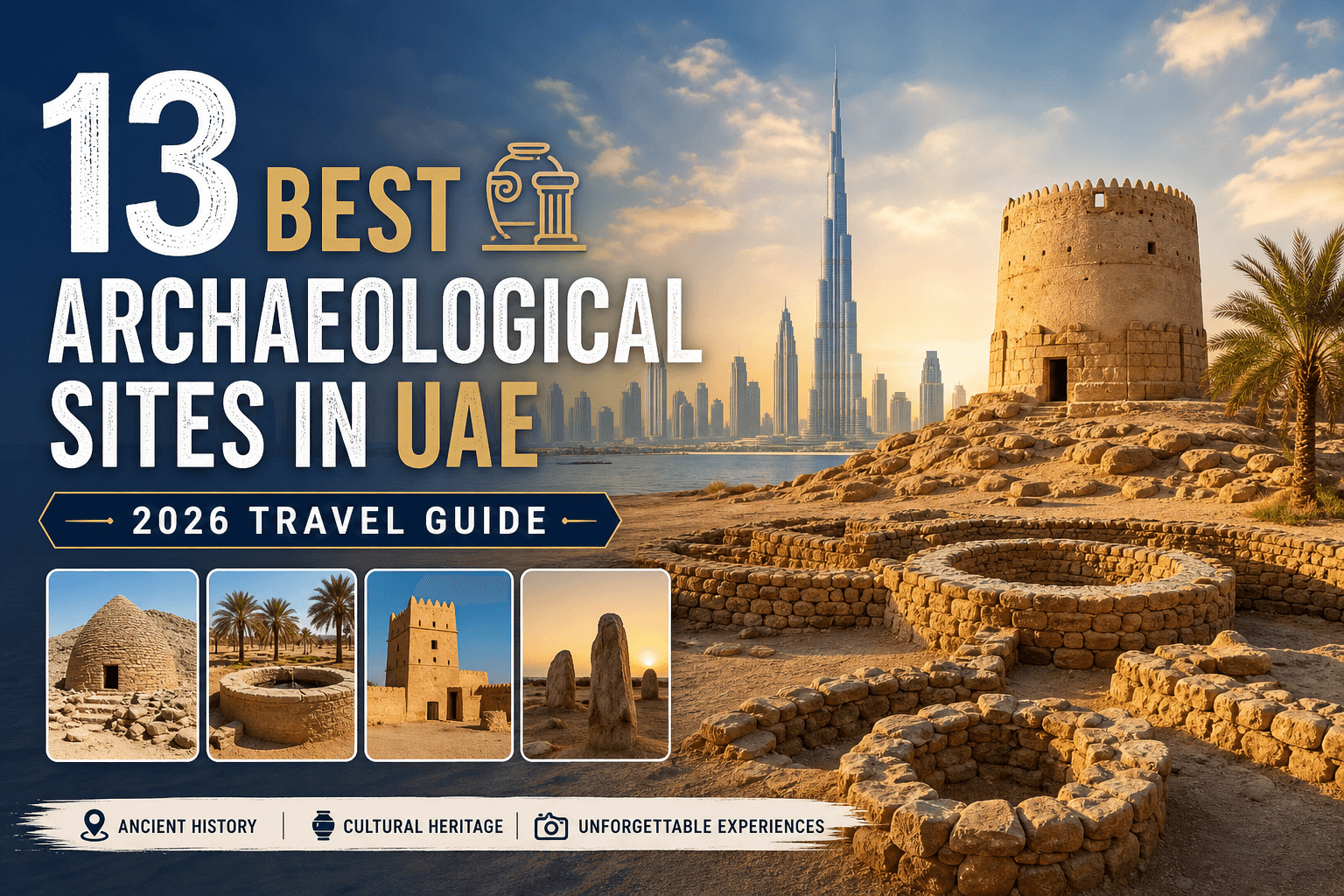
When people think of the UAE, they often picture skylines, luxury malls, and desert adventures. But the real magic lies deeper in the sand and stone, where the Archaeological Sites in UAE reveal trade routes, ancient burial grounds, fort cities, and early human settlements that shaped the country long before the modern era.
I’ve always loved how the UAE lets you move from futuristic towers to Bronze Age ruins in a single day. These places do more than fill a travel itinerary; they tell the story of survival, seafaring, faith, trade, and community across thousands of years.
Best 13 Tourist and Archaeological Sites in UAE 2026
1. Mleiha Archaeological Centre, Sharjah
Mleiha is one of the most rewarding Archaeological Sites in UAE because it shows how life unfolded in the desert long before paved roads and cities. The site sits near dramatic rock formations and open sands, and its story stretches back to the Bronze Age, Hellenistic period, and early Islamic era.
What makes Mleiha so special is the way it connects archaeology with landscape. You can see ancient tombs, old forts, and evidence of camel caravans that once crossed this region. The museum-style center helps you understand the finds without making the experience feel distant or dry.
The desert around Mleiha adds to the atmosphere. At sunset, the rocks glow gold, and it becomes easy to imagine traders and nomads moving through the same terrain centuries ago.
💡 Local Pro Tip: Go late afternoon so you can explore the site in cooler weather and catch the sunset over the desert after your visit.
2. Saruq Al Hadid Archaeology Museum, Dubai
Saruq Al Hadid is one of the most fascinating Archaeological Sites in UAE because it was once a major desert metalworking center. Hidden in the sand for centuries, it later revealed thousands of objects made from bronze, iron, gold, and other materials.
The museum is located in Dubai, but the story feels ancient and mysterious. Archaeologists believe the site may have been tied to trade, craftsmanship, and religious activity during the Iron Age, which makes it one of the most important discoveries in the region.
Inside, the displays are carefully arranged and easy to follow. You do not need to be an archaeology expert to enjoy it, and the detail in the artifacts makes the visit feel personal and alive.
💡 Local Pro Tip: Pair your visit with Dubai’s Al Fahidi Historic District for a day that combines ancient history with old-city charm.
3. Al Ain Oasis and the Hili Archaeological Park, Al Ain
Al Ain is often called the garden city of the UAE, but it is also one of the country’s richest heritage zones. The Hili area is among the key Archaeological Sites in UAE, with burial sites, ancient towers, and evidence of early agricultural life.
Hili Archaeological Park is especially memorable because it feels open, calm, and deeply connected to the land. The ancient tombs here date back thousands of years, and the surrounding oasis shows how early communities mastered water management in a harsh environment.
Walking through Al Ain gives you a sense of continuity. The palm groves, falaj irrigation channels, and archaeological remains all tell the same story: people learned how to live well in the desert by working with it, not against it.
💡 Local Pro Tip: Visit early in the morning and then stop at Al Ain Oasis nearby, where the shade makes for a peaceful break from the heat.
4. Jebel Hafeet Tombs, Al Ain
The Jebel Hafeet Tombs are one of the most striking archaeological landscapes in the UAE. Spread along the foothills of the mountain, these beehive-shaped stone tombs date back to the Bronze Age and stand as silent markers of early settlement in the area.
What I find most moving about this site is its simplicity. The tombs are not polished or curated like a museum piece; they sit in the open air, shaped by time and weather, which makes the visit feel raw and real.
The mountain backdrop adds a dramatic layer to the experience. Jebel Hafeet itself is one of the UAE’s most famous natural landmarks, and the tombs nearby prove that people were living, burying their dead, and building communities here thousands of years ago.
💡 Local Pro Tip: Drive up Jebel Hafeet after your visit for sweeping views, but go on a weekday if you want fewer cars and a quieter stop.
5. Umm Al Quwain National Museum and Fort
Umm Al Quwain may be one of the quietest emirates, but it holds a strong place among the Archaeological Sites in UAE. The fort and museum reveal a layered history of seafaring, pearl diving, and local rule that shaped life along the coast.
The fort itself gives you that classic Gulf feel, with thick walls and compact rooms that once served defensive and administrative roles. Inside the museum, archaeological finds and old photos help fill in the human side of the story.
This is a great stop for travelers who prefer slower, less crowded heritage sites. The atmosphere is relaxed, and that makes it easier to imagine what daily life looked like before the UAE became the modern nation it is today.
💡 Local Pro Tip: Combine this stop with a visit to the nearby mangroves for a rare mix of coastal heritage and nature in one day.
6. Ed-Dur Archaeological Site, Umm Al Quwain
Ed-Dur is one of the most important Archaeological Sites in UAE for anyone interested in ancient trade. This once-thriving settlement sits near the coast and dates to the pre-Islamic period, when merchants connected the Arabian Gulf with the wider region.
The site includes tombs, structures, and remains linked to a busy settlement life. Finds from Ed-Dur suggest long-distance trade, religious life, and a community that understood how to prosper by the sea.
There is something powerful about standing there and thinking about ships, goods, and people moving across waters long before modern ports existed. The site may not be flashy, but its historical value is enormous.
💡 Local Pro Tip: Bring water and sun protection, as the site is open and shade is limited, especially during midday.
7. Julfar Archaeological Area, Ras Al Khaimah
Julfar is a name that history lovers remember well. Once a major port and settlement, it played a huge role in trade, travel, and regional power, and it remains one of the standout Archaeological Sites in UAE.
Located in Ras Al Khaimah, Julfar is tied to maritime history, especially the movement of goods through the Arabian Gulf and beyond. The area helped shape the early economic life of the region, and its ruins still carry that coastal identity.
Ras Al Khaimah has done a good job of preserving and interpreting its past, so you can feel the connection between the old port world and the emirate’s modern character. It is a site that quietly rewards curious travelers.
💡 Local Pro Tip: Ask locally about the best current access points, since parts of the archaeological landscape can vary in visibility depending on conservation work.
8. Dhayah Fort and its Surrounding Heritage Zone
Dhayah Fort is famous for its hilltop setting, but the surrounding area also links to the broader story of settlement and defense in the north of the UAE. It belongs on any list of Archaeological Sites in UAE because it shows how geography shaped survival.
The fort itself is later than some other sites on this list, but the hill and surrounding region have long been important for observation and protection. Climbing the steps to the top gives you both a workout and a real sense of strategic history.
The view from the top is one of the best in Ras Al Khaimah. You can see mountains, palms, and coastal land stretching out below, which helps explain why this location mattered so much in the past.
💡 Local Pro Tip: Wear proper shoes for the climb, and go close to sunset for the best light and the most comfortable temperature.
9. Tell Abraq, Umm Al Quwain / Sharjah Border Area
Tell Abraq is one of those Archaeological Sites in UAE that serious history travelers love because of its long timeline. It shows signs of occupation from the third millennium BCE onward, making it a key location for understanding early life in the region.
The site has produced evidence of settlements, burials, and changing patterns of occupation over many centuries. That long history makes it especially valuable, because you can see how communities adapted to shifting environments and social conditions.
Tell Abraq may not have the polished visitor setup of a large museum site, but that is part of its charm. It feels authentic, like a place where the desert still keeps some of its secrets.
💡 Local Pro Tip: Visit with a local guide if possible, since the site’s significance is much easier to appreciate when someone explains its layers of history.
10. Saruq Al-Hadid Desert Zone and Open-Air Finds, Dubai
Not far from the museum, the wider Saruq Al-Hadid desert area offers another side of the story. This is one of the Archaeological Sites in UAE where the desert itself becomes part of the exhibit, with finds suggesting large-scale metalworking and ritual activity.
The open-air context matters here. When you look at the sand and rocks, it is easier to understand how a place can remain hidden for so long, then suddenly reveal a major chapter of human history.
This area also reminds visitors that archaeology in the UAE is not limited to fixed monuments. Sometimes the most important discoveries are scattered, subtle, and only understood when connected through careful research.
💡 Local Pro Tip: If you are short on time, visit the museum first and use that background to make the surrounding desert site more meaningful.
11. Jumeirah Archaeological Site, Dubai
Jumeirah is one of the most accessible Archaeological Sites in UAE, and it sits in a place many travelers already pass through without realizing its importance. The remains date mainly to the Abbasid period and show that Dubai’s history stretches far beyond the modern city.
The site once formed part of a settlement linked to trade and daily life along the coast. Walking through the preserved foundations, you get a rare glimpse of early urban life in what is now one of the world’s busiest cities.
What I like most about Jumeirah is the contrast. You stand near modern roads and elegant neighborhoods, yet the ruins remind you that history is never far below the surface in the UAE.
💡 Local Pro Tip: Visit in the cooler months and combine it with a stop at nearby old Dubai areas for a fuller historical day.
12. Sir Bani Yas Island Archaeological Monastery, Abu Dhabi
Sir Bani Yas Island is famous for its wildlife reserve, but its archaeological monastery is one of the most unexpected treasures in the country. This is among the most remarkable Archaeological Sites in UAE because it reflects the region’s early Christian history.
The monastery dates back to the 7th or 8th century and offers a rare look at religious life in the Gulf before the spread of Islam across the region. The remains are modest, but their meaning is huge.
Visiting the site feels peaceful and reflective. The island’s quiet setting, combined with the monastery ruins, creates a powerful sense of continuity between faith, nature, and settlement history.
💡 Local Pro Tip: Plan enough time for the island experience, since ferry schedules and activity timings can shape your whole day.
13. Al Bidya Mosque and Surrounding Ancient Landscape, Fujairah
Al Bidya Mosque is often known as the oldest mosque in the UAE, but the surrounding area also adds archaeological interest. The nearby landscape and coastal setting make it one of the most meaningful heritage stops in the country.
The mosque itself is small, simple, and deeply atmospheric. Its design reflects local building traditions, and its age gives it an emotional weight that larger monuments sometimes lack.
As part of the wider heritage story, Al Bidya connects faith, settlement, and survival in the eastern part of the UAE. It is a place where the mountains and sea seem to hold the memory of old communities.
💡 Local Pro Tip: Visit in the late afternoon, then continue along the Fujairah coast for beautiful views and a quieter heritage route.
14. Al Faya and the Sharjah Desert Stone Age Sites
The Al Faya area is one of the most exciting Archaeological Sites in UAE for visitors interested in prehistoric human movement. Evidence from this region has helped researchers understand some of the earliest occupations in the Arabian Peninsula.
This is not just a site with artifacts. It is part of a wider desert story about migration, adaptation, and survival in one of the world’s toughest environments. For archaeology fans, that makes it deeply rewarding.
The beauty of Al Faya lies in its sense of scale. You are looking at a landscape that once held some of the earliest traces of human presence in the region, which makes even a quiet stop feel important.
💡 Local Pro Tip: Check access arrangements before going, as some areas are best visited with a guide or as part of a curated heritage tour.
15. Muweilah Archaeological Site, Sharjah
Muweilah is one of the most significant Archaeological Sites in UAE from the Iron Age, and it has helped reshape what we know about early settlement in the region. Archaeologists found evidence of a large community, including pottery, tools, and traces of daily life.
The site is especially interesting because it shows organization, trade, and local resilience in a time when communities were building the foundations of later regional life. It is a reminder that the UAE’s story is not only about coastal trade; it is also about inland settlement and continuity.
For travelers, Muweilah is one of those places that quietly expands your understanding of the country. It may not be as famous as a skyline landmark, but its value is immense if you care about history that still breathes under the surface.
💡 Local Pro Tip: Visit with a heritage-focused itinerary in Sharjah so you can compare Muweilah with nearby museums and get a stronger sense of the Iron Age in context.
Frequently Asked Questions (FAQs)
What is the best time to visit archaeological sites in the UAE?
The best time is from November to March, when temperatures are cooler and outdoor exploration is much more comfortable.
Are these archaeological sites suitable for families?
Yes, many are family-friendly, especially sites with museums or visitor centers like Mleiha, Al Ain, and Saruq Al Hadid.
Do I need a guide to understand the sites?
A guide is not required, but it can make a huge difference. Many Archaeological Sites in UAE become much more meaningful when someone explains the history and context.
Can I visit these sites using public transport?
Some city sites are accessible by taxi or public transport, but many desert and heritage locations are easier to reach by car or organized tour.
Your Next Adventure Awaits
The UAE is far more than a modern luxury destination. Its ancient tombs, desert settlements, fortresses, monasteries, and trade sites reveal a layered past that is still alive in the land today.
If you are planning a trip, let these Archaeological Sites in UAE guide you beyond the usual postcard views. Travel Atlas Guide invites you to explore the stories beneath the skyline and discover a country where history still rises from the sand.