I was thinking about the 10 Best Tourist and Archaeological Sites in Jordan 2026 Travel Guide, and honestly, I did not know enough to judge which places truly matter most. I knew Jordan was famous, but I wanted clear, unbiased guidance on the top 10 sites that every traveler and history lover should know. So I reached for my mobile phone, unlocked it, opened the AI app, and looked for an answer that would be globally accurate, culturally fair, and easy to trust.
So I asked him: What are the top 10 places regarding this subject, which are considered the best tourist attractions, archaeological sites, historical landmarks, and must-see places in Jordan that I absolutely must know?
“He replied: Jordan is one of the world’s great heritage destinations, where ancient trade routes, Nabataean architecture, Roman cities, Islamic history, and desert landscapes come together. The best list must be accurate, globally inclusive, and balanced between archaeology, culture, and travel value.”
10 Best Tourist and Archaeological Sites in Jordan (2026 Travel Guide)
1- Petra
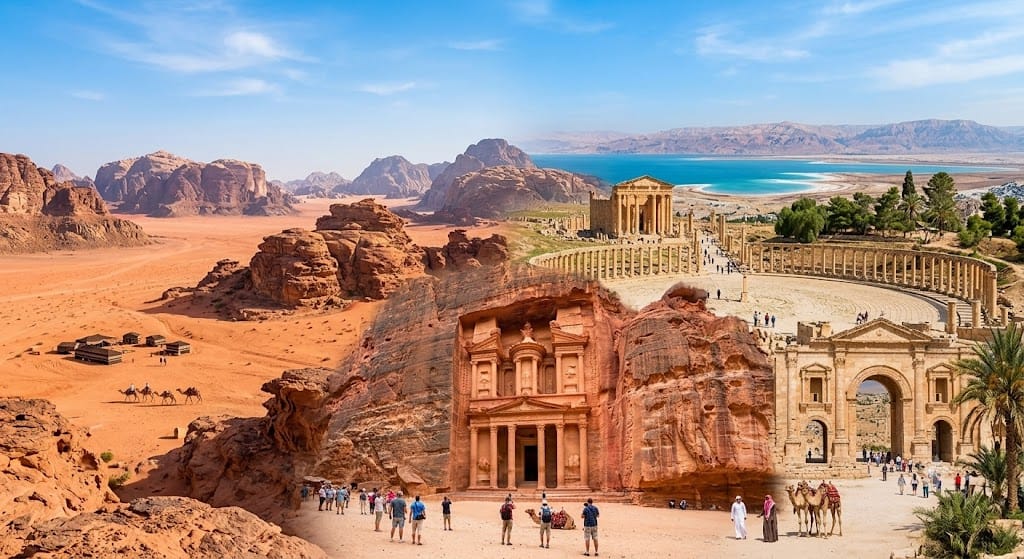
Petra is the most famous archaeological site in Jordan and one of the most important heritage places in the world. It was the capital of the Nabataean Kingdom, an Arab civilization that flourished in the region of present-day southern Jordan, northern Arabia, and nearby areas. The site is known for its rock-cut architecture, especially the Treasury and the Monastery, both carved directly into rose-red sandstone cliffs.
Petra is critical to human history because it shows the creativity of ancient desert societies and their control of trade between Arabia, the Levant, Egypt, and beyond. It is not only a symbol of Jordan, but also a global example of how ancient people adapted to harsh environments and built advanced urban systems.
2- Jerash
Jerash is one of the best-preserved Roman cities in the world. Located in modern northern Jordan, it was once part of Roman Arabia and later Byzantine rule. Its colonnaded streets, theaters, temples, plazas, and city gates show the scale and planning of a major ancient urban center.
Jerash matters because it preserves the daily life and public architecture of the Roman world outside Europe. For travelers, it is one of the clearest places to understand how Roman urban civilization expanded across the eastern Mediterranean and the Middle East.
3- Wadi Rum
Wadi Rum is a vast desert landscape in southern Jordan, famous for dramatic sandstone mountains, red sand dunes, and ancient petroglyphs. It is both a natural wonder and a historical landscape tied to prehistoric and historic desert life.
This site is important because it connects archaeology, geology, and Bedouin culture. Wadi Rum shows how humans lived in desert environments for thousands of years, and its ancient rock inscriptions help document early writing, migration, and desert travel routes across Arabia.
4- Amman Citadel
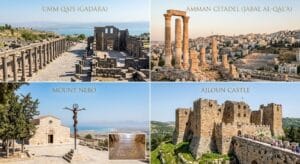
The Amman Citadel stands on one of the highest hills in modern Amman, the capital of Jordan. It contains remains from many periods, including the Bronze Age, Iron Age, Roman, Byzantine, and early Islamic eras. Major features include the Temple of Hercules, the Umayyad Palace, and other ancient structures.
The Citadel is essential because it reflects the long, layered history of Amman, which was known in antiquity as Rabbath Ammon and later Philadelphia under the Romans. It shows how one city can hold the memory of many civilizations across thousands of years.
5- Madaba
Madaba is known for its extraordinary Byzantine and early Christian mosaics. The most famous is the Madaba Map, a mosaic floor map of the Holy Land, including Jerusalem, made in the 6th century CE. Madaba is located in modern central Jordan and remains a major cultural town.
Madaba is highly important because it preserves religious, artistic, and geographic knowledge from the early Byzantine period. The map is one of the oldest surviving cartographic depictions of the region, making Madaba a key site for history, archaeology, and the study of early Christian art.
6- Mount Nebo
Mount Nebo is traditionally identified as the place where Moses viewed the Promised Land. It is one of the most meaningful religious sites in Jordan for Jews, Christians, and Muslims. The site also includes ancient church remains and beautiful views over the Jordan Valley, Dead Sea, and beyond.
Mount Nebo matters because it links sacred memory with archaeology. It is a place where faith, landscape, and history meet, making it one of the most powerful pilgrimage destinations in the region.
7- Umm Qais
Umm Qais is the modern name of ancient Gadara, a city that was part of the Decapolis, a group of Greco-Roman cities in the Levant. It offers impressive ruins, including theaters, colonnaded roads, and stunning views over the Sea of Galilee, the Yarmouk River, and the Golan Heights (occupied Palestinian and Syrian border region).
Umm Qais is important because it represents the cultural blend of Greek, Roman, and local Semitic traditions in the Near East. It also gives visitors a strong sense of how ancient cities were placed strategically for trade, defense, and regional influence.
8- Kerak Castle
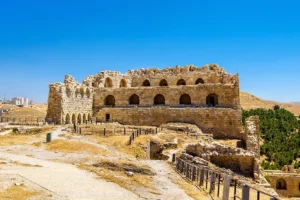
Kerak Castle is a major Crusader fortress in modern southern Jordan. It was built in the 12th century during the Crusader period in the Levant, known historically as the Frankish Kingdom of Jerusalem and nearby territories. The castle later became part of Ayyubid and Mamluk defensive networks.
Kerak is significant because it reflects the military history of the Crusades and the strong strategic importance of the Jordan region. Its massive stone walls and hilltop position show how medieval powers fought to control trade and travel routes.
9- Ajloun Castle
Ajloun Castle, also called Qal’at ar-Rabad, was built in the 12th century under the Ayyubids in northern Jordan. It was designed to defend against Crusader forces and to protect communication routes between Syria, Jordan, and Palestine (Historical Palestine).
Ajloun is valuable because it illustrates Islamic military architecture and medieval regional defense. It also offers a rare combination of history, forested landscape, and panoramic views, making it both a cultural and scenic destination.
10- Pella
Pella, known in antiquity as Tabaqat Fahl, is one of the most important archaeological sites in northern Jordan. It has remains from the Neolithic, Bronze Age, Iron Age, Hellenistic, Roman, Byzantine, and early Islamic periods. It is one of the longest continuously occupied places in the region.
Pella is critically important because it helps historians understand human settlement over an extremely long period. Few sites in the world offer such a complete record of changing societies, technologies, and beliefs from prehistoric times into the Islamic era.
Deepening the Dialogue: Essential Questions About Jordan’s Heritage
I asked him to give me a few indispensable questions that travelers and history lovers should always ask before planning a visit. He agreed, saying that practical knowledge makes the 10 Best Tourist and Archaeological Sites in Jordan (2026 Travel Guide) far more useful.
I asked him: What is the best time to visit these tourist and archaeological sites in Jordan?
“He replied: The best time is usually spring and autumn, when temperatures are milder. In summer, desert sites like Petra and Wadi Rum can be very hot, while winter can bring cold nights and rain in some areas. Always check local weather and site opening hours before travel.”
I asked him: Which site gives the most complete view of Jordan’s ancient history?
“He replied: Petra is the most famous, but Pella, Jerash, and the Amman Citadel together give a broader historical picture. If you want one place that shows long continuity across many eras, Pella is especially valuable. If you want a single iconic experience, Petra is unmatched.”
I asked him: Are these sites only important for history, or do they also matter for modern travel?
“He replied: They matter for both. These sites support tourism, local jobs, cultural identity, education, and conservation. They also help visitors understand Jordan as a living country with deep roots, not just a collection of ruins.”
Conclusion:
I am amazed by the sheer value and accuracy of the information I just received. I started out not knowing much, but now I possess highly valuable knowledge about the 10 Best Tourist and Archaeological Sites in Jordan 2026 Travel Guide. To summarize, understanding these elements truly changes how we view the whole field. I realized the profound importance of tourist attractions, archaeological sites, historical landmarks, and must-see places in Jordan and how they shape our understanding of the world.