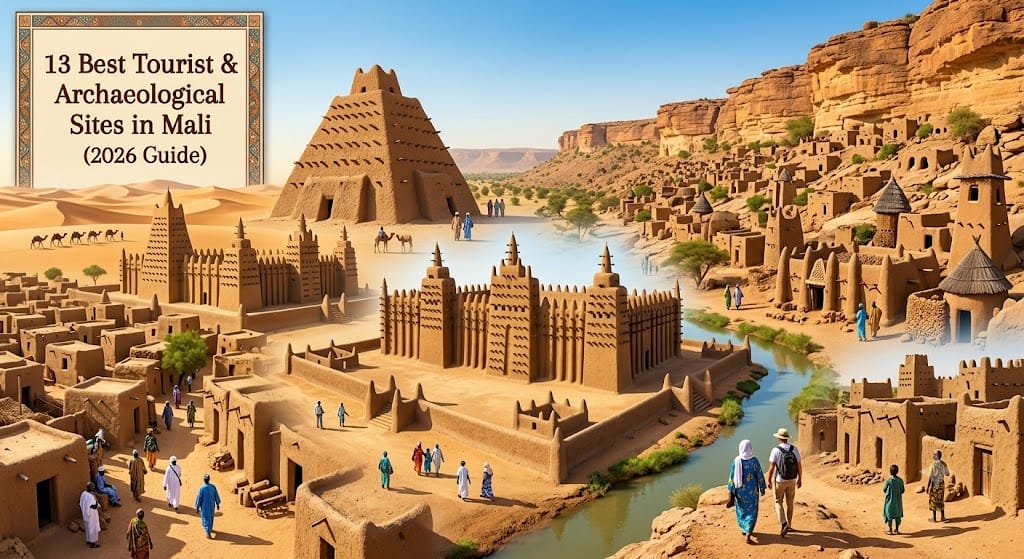
I was thinking about 13 Best Tourist and Archaeological Sites in Mali (2026 Travel Guide), and honestly, I did not know enough to judge which places truly matter most. Mali is not just one place on a map. It is a deep cultural world shaped by the Sahara, the Niger River, ancient trade routes, empires, sacred landscapes, and living traditions.
I reached for my mobile phone, unlocked it, and opened the AI app because I wanted a list that was not biased, not shallow, and not limited to one region’s view of history. I wanted the most accurate global picture possible.
So I asked him: What are the top 13 entities regarding this subject, which are considered the best tourist sites, archaeological sites, Mali travel destinations, UNESCO heritage sites, and historical landmarks that I absolutely must know?
He replied: Mali is one of the world’s great heritage countries. Its sites connect Saharan trade, African architecture, spiritual traditions, early scholarship, and archaeological memory. I will give you a carefully chosen, globally accurate, and unbiased list of the 13 most important places to know in Mali.
13 Best Tourist and Archaeological Sites in Mali (2026 Travel Guide)
1. Timbuktu
Timbuktu is one of the most famous heritage cities in the world. Located near the edge of the Sahara in present-day Mali, it was once a major center of trans-Saharan trade, Islamic scholarship, and manuscript culture. Its historic reputation spread across Africa, the Middle East, and Europe.
What makes Timbuktu so important is not only its legend. It was a real intellectual center with libraries, scholars, and manuscript traditions that still matter today. The city’s mosques and manuscripts are vital evidence of West African learning and urban life.
2. Djenné and the Great Mosque of Djenné
Djenné is one of the most iconic cities in Mali and a masterpiece of Sudano-Sahelian architecture. The Great Mosque of Djenné, rebuilt in 1907 on the site of earlier mosques, is the largest mud-brick building in the world.
This site matters because it shows how local materials, climate knowledge, and religious life can create enduring architecture. The annual replastering ceremony is also a powerful example of community participation and living heritage.
3. Bandiagara Escarpment and the Cliffs of Dogon Land
The Bandiagara Escarpment, in the region associated with Dogon Country (present-day central Mali), is one of Africa’s most impressive cultural landscapes. The cliffs contain ancient settlements, grain storage structures, ceremonial spaces, and archaeological remains linked to different communities over time.
This site is important because it reveals how people built lives in a difficult environment. It is also deeply tied to Dogon cultural identity, oral tradition, and ritual knowledge.
4. Sankoré Mosque and the Timbuktu Mosque Complex
The Sankoré Mosque in Timbuktu is part of a wider scholarly landscape that once included major centers of education and manuscript study. It represents the intellectual life that made Timbuktu globally significant.
Its importance lies in the fact that Africa has long had advanced traditions of learning. Sankoré helps correct the false idea that formal scholarship was only a feature of a few world regions.
5. Gao and the Ancient Songhai Heartland
Gao, on the Niger River in present-day eastern Mali, was a major political center of the Songhai Empire. The area contains archaeological and historical traces linked to one of the most powerful states in African history.
Gao matters because it connects river trade, empire-building, and urban development. It also helps explain how the Niger River supported settlement and power in the Sahel.
6. The Tomb of Askia
The Tomb of Askia in Gao is one of the most important surviving monuments of the Songhai Empire. Built for Askia Muhammad, it stands as a symbol of royal authority, Islamic practice, and Sahelian building tradition.
This site is critically important because it shows the blending of political power and religious identity. Its form also reflects the skill of local builders working with earth and timber.
7. Oualata-Linked Caravan and Trade Heritage in Northern Mali
Northern Mali was part of the wider trans-Saharan caravan world that connected West Africa with North Africa and beyond. While Oualata itself is in present-day Mauritania, the trade routes that reached Mali are essential to understanding Mali’s archaeological and tourist heritage.
This broader caravan heritage matters because it explains how gold, salt, books, cloth, and ideas moved across the desert. Mali’s historical sites cannot be understood without this network.
8. Hombori and the Hombori Tondo Area
Hombori, in present-day central-eastern Mali, is known for dramatic rock formations, traditional settlements, and landscape beauty. Hombori Tondo, one of Mali’s highest points, is a striking natural and cultural landmark.
This area is important for both tourism and archaeology because it shows the long relationship between people and landscape. It is also a valuable place for understanding adaptation in semi-arid environments.
9. Ségou
Ségou, on the Niger River in present-day southern-central Mali, is a historic city with strong cultural identity, royal history, and artistic importance. It was associated with the Bambara Empire and later became an important colonial and postcolonial center.
Ségou matters because it brings together river civilization, political history, crafts, music, and living culture. It is also one of the best places to understand everyday Malian heritage in a city setting.
10. Mopti
Mopti, often called the “Venice of Mali,” is a major river port and trading city at the meeting point of waterways in present-day central Mali. It has long served as a commercial and cultural hub.
Mopti is important because it shows how geography shapes urban life. The city connects river transport, markets, fishing, and movement between different ethnic and cultural communities.
11. Niafunke and the Inland Niger Delta Cultural Landscape
Niafunke, in present-day central Mali, is linked to the wider Inland Niger Delta, one of West Africa’s richest wetland systems. This landscape has supported fishing, farming, herding, and settlement for centuries.
Its value is both ecological and historical. The area shows how communities live with seasonal flooding and changing water levels. This makes it a key place for understanding human resilience.
12. Kouroukan Fouga Area in the Wider Mandé Historical Zone
Kouroukan Fouga is associated with the oral memory of the Mandé world and the founding tradition of the Mali Empire in present-day southern Mali. It is not a single museum-style monument, but a historically powerful cultural reference point.
It matters because it represents political memory, legal tradition, and social organization in African history. Oral heritage is a serious historical source, and Kouroukan Fouga is central to that understanding.
13. The Cave and Cliff Heritage Sites of Dogon Country
Beyond the better-known escarpment settlements, Dogon Country contains many smaller cave, cliff, and village heritage locations in present-day central Mali. These places include old habitations, ritual spaces, and archaeological remains.
These sites are important because they show diversity within one cultural region. They remind us that heritage is not only in large famous monuments. It is also in smaller landscapes shaped by survival, belief, and continuity.
Deepening the Dialogue: Practical Questions About Mali’s Heritage
I asked him if he could answer a few more practical questions that travelers and history lovers often forget to ask. He said these questions were essential.
I asked him: Which Mali site is best for first-time visitors who want both history and culture?
“He replied: Timbuktu and Djenné are the strongest starting points for understanding Mali’s heritage, but your choice depends on access and security conditions. Djenné is especially powerful for architecture and living tradition, while Timbuktu is unmatched for manuscript history and scholarly legacy.”
I asked him: What makes Mali’s archaeological and tourist sites different from those in many other countries?
“He replied: Mali’s sites are different because they combine ancient urban history, Islamic scholarship, desert trade, earth architecture, river culture, and living oral traditions. Many places are not frozen ruins. They are still part of community life.”
I asked him: Why is it important to include modern-day locations when talking about historical sites?
“He replied: It prevents confusion and improves accuracy. Many historical names belong to old empires or cultural regions, but travelers need to know the modern country and province. That is why clear geographic labeling is essential for global understanding.”
Final Reflection on Mali’s Heritage
I am amazed by the sheer value and accuracy of the information I just received. I started out not knowing much, but now I possess highly valuable knowledge about this topic. To summarize, understanding these elements truly changes how we view the whole field. I realized the profound importance of tourist sites, archaeological sites, Mali travel destinations, UNESCO heritage sites, and historical landmarks and how they shape our understanding of the world.