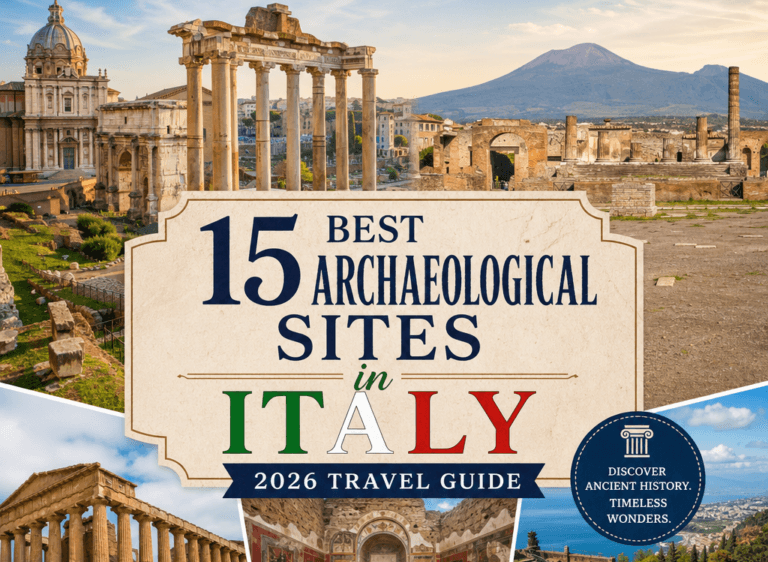
Italy is one of those rare countries where every street seems to whisper history. If you love ancient ruins, grand temples, and cities shaped by empires, this guide to the best Archaeological Sites in Italy will give you a travel plan that feels both timeless and alive.
What makes Italy special is not just the age of its sites, but how well they connect to daily life today. You can walk through Roman forums in the morning, eat lunch in a modern café, and end the day watching the sunset over ruins that have stood for thousands of years.
15 Best Tourist and Archaeological Sites in Italy (2026 Travel Guide)
1- Pompeii Archaeological Park, Campania
Pompeii is the most famous of all Archaeological Sites in Italy, and it still feels shocking the first time you walk its streets. The city was buried by Mount Vesuvius in 79 AD, freezing a Roman world in ash and preserving homes, bakeries, baths, and even painted walls.
The grid of streets makes it easy to imagine daily life here. You can see where people shopped, prayed, and gathered in public spaces, which is why Pompeii feels less like a ruin and more like a stopped clock.
Spend time at the Forum, the amphitheater, and the Villa of the Mysteries. These are the places where the city’s scale and beauty really come alive.
💡 Local Pro Tip: Arrive right at opening time and enter with a small backpack only. The crowds grow fast by late morning, and the quieter early hours make Pompeii far easier to enjoy.
2-Herculaneum, Campania
Herculaneum is smaller than Pompeii, but many travelers say it feels even more vivid. It was also buried by Vesuvius, yet the volcanic material sealed in wood, doors, and upper floors in a way that has helped preserve rare details.
You can still see mosaics, frescoes, and elegant seaside homes with astonishing clarity. Compared with other Archaeological Sites in Italy, Herculaneum often feels more intimate and easier to absorb in a few hours.
The site also reveals the social side of Roman life, from bathing culture to private dining rooms. It is a place that rewards slow wandering and careful looking.
💡 Local Pro Tip: Pair Herculaneum with a visit to the National Archaeological Museum in Naples. The two together give you the best picture of how this ancient Roman world really looked and lived.
3- Colosseum and Roman Forum, Rome
No trip through Archaeological Sites in Italy is complete without Rome’s great imperial heart. The Colosseum remains the strongest symbol of Roman power, while the nearby Forum was once the center of politics, religion, and public life.
Standing inside the Colosseum, you can almost hear the roar of the crowds. Just a short walk away, the Forum offers a different feeling, with ruined temples, triumphal arches, and the sacred hill of the Vestals.
Try to visit both with a guide or audio tour. The stories behind the stones make the space much richer, especially when you understand how the Roman world worked.
💡 Local Pro Tip: Book a combined ticket for the Colosseum, Forum, and Palatine Hill, and choose a late-afternoon slot if you can. The light is softer, and the heat is much easier to handle.
4- Palatine Hill, Rome
Palatine Hill is one of the oldest and most important archaeological areas in Rome. According to legend, this is where Romulus founded the city, and later emperors chose it for their palaces because of the views and prestige.
Walking here gives you a calmer experience than the crowded Colosseum below. The gardens, ruins, and panoramic terraces make Palatine Hill one of the most atmospheric Archaeological Sites in Italy.
You can still trace the outlines of imperial life through fragments of walls, courtyards, and monumental residences. It is a place where myth and history blend beautifully.
💡 Local Pro Tip: Bring water and wear good walking shoes. Palatine Hill has uneven paths and less shade than many visitors expect, so it is best explored in the cooler part of the day.
5- Roman Forum, Rome
The Roman Forum was the civic and ceremonial center of ancient Rome, and it remains one of the most important Archaeological Sites in Italy. This was where elections were held, speeches were given, and major events shaped the empire.
The ruins are spread out, but that is part of the magic. As you move through arches, columns, and broken temples, the scale of ancient Rome becomes easier to understand.
Look for the Temple of Saturn, the Arch of Septimius Severus, and the Curia. These landmarks help explain how Roman power worked in everyday life.
💡 Local Pro Tip: Visit the Forum after seeing the Colosseum, not before. The experience makes more sense once you already understand how connected these spaces were in ancient Rome.
6- Ostia Antica, near Rome
Ostia Antica is one of the best-preserved ancient port cities in Europe, and it is a hidden treasure among Archaeological Sites in Italy. Once Rome’s main harbor, it was a busy commercial center full of warehouses, taverns, baths, and apartment blocks.
The site feels wonderfully walkable. You can wander through streets lined with mosaics and brick buildings, which gives you a real sense of how ordinary Romans lived outside the capital.
Because it is less crowded than central Rome, Ostia Antica is perfect for travelers who want a slower, more immersive archaeological visit. It also works well as a half-day trip.
💡 Local Pro Tip: Bring snacks and plan a relaxed pace. The site is larger than it looks on the map, and the quiet corners are often the most memorable.
7- Paestum, Campania
Paestum is famous for its majestic Greek temples, which are among the best preserved in the Mediterranean. This is one of the most striking Archaeological Sites in Italy because it shows how deeply Greek culture shaped southern Italy.
The Temple of Hera, Temple of Neptune, and Temple of Athena stand in open fields that feel almost sacred. Their golden stone changes color through the day, making the site especially beautiful in soft morning or late afternoon light.
The nearby museum is worth visiting too, especially for its painted tombs and local artifacts. Together, they tell the story of a city that was Greek, then Roman, and still feels alive today.
💡 Local Pro Tip: Stay until sunset if possible. The temples glow beautifully in the evening light, and the atmosphere becomes much quieter after the tour groups leave.
8- Valley of the Temples, Agrigento, Sicily
The Valley of the Temples is one of Sicily’s greatest treasures and one of the most dramatic Archaeological Sites in Italy. The site sits on a ridge overlooking the sea, where a line of ancient Greek temples rises from olive groves and open fields.
The Temple of Concordia is especially famous because of its near-perfect proportions. Even though the city of ancient Akragas is long gone, the temples still command the landscape with real power.
This is a place where history feels grand and cinematic. The combination of ruins, sky, and sea makes it unforgettable.
💡 Local Pro Tip: Go late in the day and check the weather before you visit. The site can be hot and exposed, and evening light gives the best photos by far.
9- Syracuse Archaeological Park, Sicily
Syracuse was once one of the greatest cities in the ancient Greek world, and its archaeological park shows exactly why. The park includes a huge Greek theater, a Roman amphitheater, and the famous Ear of Dionysius cave.
This is one of the most layered Archaeological Sites in Italy, because it reflects Greek, Roman, and later histories in one compact area. The scale is impressive, but the natural setting makes it feel almost dreamlike.
The Greek theater is still used for performances, which adds a living cultural link to the ancient past. That connection makes Syracuse especially special for travelers who love history that still breathes.
💡 Local Pro Tip: Combine the archaeological park with Ortigia, Syracuse’s old island center. The contrast between ancient ruins and lively streets is one of the best experiences in Sicily.
10- Agrippa’s Villa and Hadrian’s Villa, Tivoli
Hadrian’s Villa in Tivoli is a vast imperial retreat that shows the luxury of Roman power at its peak. Built for Emperor Hadrian in the 2nd century AD, it includes pools, baths, gardens, courtyards, and architectural experiments from across the empire.
This is one of the most fascinating Archaeological Sites in Italy because it feels like a Roman world in miniature. You can see influences from Egypt, Greece, and the Near East woven into one complex estate.
The nearby Villa d’Este is a great bonus if you have time. Together, the two sites make Tivoli one of the smartest day trips from Rome.
💡 Local Pro Tip: Wear comfortable shoes and allow more time than you think. The villa complex is huge, and some of the best corners are farther apart than first-time visitors expect.
11- Segesta Archaeological Park, Sicily
Segesta sits in a dramatic hill country setting, far from major cities, which adds to its mystique. The unfinished Doric temple and the ancient theater are the stars here, and both overlook wide Sicilian landscapes.
Among Archaeological Sites in Italy, Segesta stands out for its sense of isolation and elegance. The temple has no roof and no obvious city around it, which makes it feel almost like a vision left behind.
The theater, perched high above the valley, offers some of the most beautiful views in western Sicily. It is easy to see why ancient audiences would have remembered performances here for life.
💡 Local Pro Tip: Visit on a clear day if you can. The views from the theater are one of the main reasons to come, and they are best when the horizon is open.
12- Etruscan Necropolises of Cerveteri and Tarquinia, Lazio
These UNESCO-listed necropolises open a rare window into the world before Rome rose to power. The painted tombs and burial mounds show the beliefs, rituals, and artistry of the Etruscan civilization.
This is one of the most intriguing Archaeological Sites in Italy because it tells a story many travelers barely know. The Etruscans shaped early Roman religion, engineering, and urban life in ways that still matter.
Tarquinia is especially known for its vivid tomb paintings, while Cerveteri impresses with its vast burial landscape. Together, they form one of the best archaeological day trips in central Italy.
💡 Local Pro Tip: If you only have time for one stop, choose Tarquinia for the painted tombs. They are easier to appreciate quickly, and the museum helps explain the symbolism.
13- Aquileia Archaeological Area, Friuli Venezia Giulia
Aquileia was once one of the most important cities of the Roman Empire in northern Italy. Its remains now include basilicas, mosaics, a river port, and traces of a city that linked the Mediterranean to Central Europe.
The mosaics are especially unforgettable, with geometric and symbolic designs that still feel fresh after centuries. As one of the less-visited Archaeological Sites in Italy, Aquileia offers deep history without the heavy crowds.
The atmosphere is calm and rural, which makes the ruins feel even more poignant. It is the kind of place that quietly surprises travelers who take the time to reach it.
💡 Local Pro Tip: Visit the basilica early and then explore the open archaeological area before lunch. The site is peaceful in the morning and easier to enjoy before the heat rises.
14- Matera’s Rock Churches and Archaeological Landscape, Basilicata
Matera is famous for its Sassi cave dwellings, but its archaeological value goes far beyond its dramatic scenery. The rock-cut churches and ancient settlement layers make it one of the most unique archaeological destinations in southern Italy.
This area shows how people adapted to the natural limestone landscape over thousands of years. Religious frescoes, cave homes, and hidden passageways make Matera feel both ancient and deeply human.
It is not a traditional ruin field, which is part of the appeal. Instead, it offers a living archaeological landscape where history is woven into the city itself.
💡 Local Pro Tip: Stay overnight if you can. Matera becomes magical after dark, when the cave city glows and the daytime crowds begin to fade.
15- Selinunte Archaeological Park, Sicily
Selinunte is one of the largest archaeological parks in Europe, and it is a must for anyone serious about Archaeological Sites in Italy. The ruins of temples and ancient streets spread across a windswept coastal plain, creating a powerful sense of scale.
The site was once a rich Greek colony, and the remains of its temples still dominate the landscape. Even in ruins, Selinunte feels monumental, especially when the wind comes in from the sea.
The wide-open setting gives you space to think and wander. It is less polished than some famous sites, but that rawness is part of its beauty.
💡 Local Pro Tip: Bring sun protection and plan for strong wind near the coast. Selinunte is best explored slowly, with time to sit and absorb the landscape around the ruins.
Frequently Asked Questions (FAQs)
1. What is the best time of year to visit archaeological sites in Italy?
Spring and autumn are ideal. The weather is milder, crowds are smaller, and walking around outdoor ruins is much more comfortable.
2. Do I need to book tickets in advance?
Yes for major sites like Pompeii, the Colosseum, and Hadrian’s Villa. Advance booking helps you avoid long lines and secure better entry times.
3. Are guided tours worth it?
Absolutely, especially at large sites with limited signage. A good guide helps you understand what you are seeing and brings the history to life.
4. Which sites are best for a first-time visitor to Italy?
Pompeii, the Colosseum and Roman Forum, Paestum, and the Valley of the Temples are excellent first choices. They are iconic, well-preserved, and easy to pair with nearby cities.
Your Next Adventure Awaits
Italy is not just a country of museums and monuments. It is an open-air archive of empires, myths, faiths, and everyday lives, and these 15 stops prove how powerful that story can be.
From the buried streets of Pompeii to the temple fields of Sicily, every place on this list offers a different way to understand the past. If you are planning a trip that blends beauty, history, and discovery, keep these Archaeological Sites in Italy at the top of your list and let Travel Atlas Guide lead the way.