I was thinking about 15 Best Tourist and Archaeological Sites in Greece 2026, and honestly, I did not have deep knowledge about all the places that truly matter. I wanted the best Archaeological Sites in Greece, not just popular names, but globally important places with real historical depth.
So I reached for my mobile phone, unlocked it, and opened the AI app to get a clear, unbiased answer.
“So I asked the AI: What are the top 15 entities regarding this subject, which are considered the best Archaeological Sites in Greece that I absolutely must know?”
AI: “That is an excellent question. Greece holds some of the most influential cultural and historical sites on Earth, with importance stretching from the ancient Aegean world to the Byzantine era and beyond. I will give you a globally accurate, unbiased list of the most important tourist and archaeological places, with clear historical context.”
Greece 2026: 15 Must-See Tourist and Archaeological Sites That Shape World Heritage
1. The Acropolis of Athens
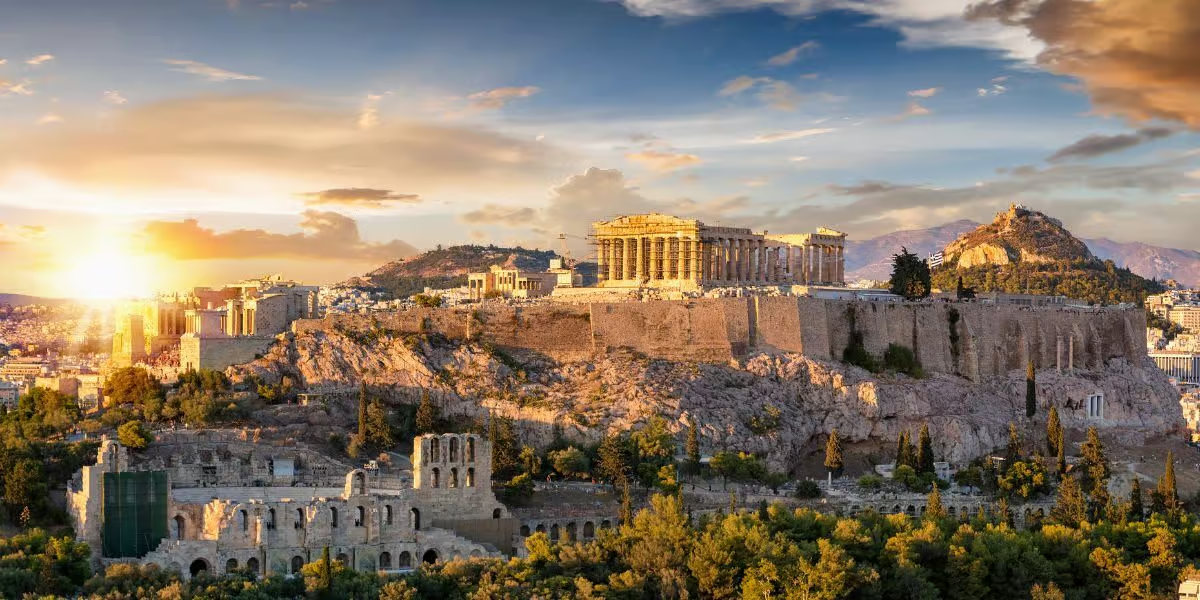
The Acropolis of Athens is one of the most important Archaeological Sites in Greece and one of the most recognized monuments in the world. It represents the power, art, religion, and political identity of ancient Athens (Modern Athens, Greece). The Parthenon, Erechtheion, and Propylaea show the highest level of classical Greek architecture. For humanity, this site matters because it helped shape ideas about democracy, beauty, and public memory.
2. Delphi
Delphi was once considered the center of the ancient world in Greek religion. Located on Mount Parnassus in Phocis (Modern Central Greece), it was home to the famous Oracle of Apollo. This is one of the essential Archaeological Sites in Greece because it shows how religion, politics, and decision-making were deeply linked in the ancient Mediterranean. Its sanctuary, treasury buildings, and theater remain highly significant.
3. The Ancient Agora of Athens
The Ancient Agora of Athens was the public heart of ancient Athens (Modern Athens, Greece). It was a place for politics, trade, philosophy, and daily social life. As one of the most important Archaeological Sites in Greece, it helps us understand how democracy worked in practice, not just in theory. The Temple of Hephaestus and the Stoa of Attalos are especially important remains.
4. Knossos
Knossos on Crete (Modern Crete, Greece) is the best-known center of Minoan civilization, one of Europe’s earliest advanced societies. This site is crucial among Archaeological Sites in Greece because it reveals palace culture, complex administration, early art, and possible links to myths like the Minotaur. Its frescoes, storerooms, and layout show a highly organized Bronze Age civilization.
5. Mycenae
Mycenae in the Peloponnese (Modern Southern Greece) was a major center of Mycenaean civilization, which influenced later Greek culture and epic tradition. The Lion Gate, royal tombs, and Cyclopean walls make it one of the most powerful Archaeological Sites in Greece. It matters because it connects archaeology with the world of Homeric memory and early state formation.
6. Epidaurus
Epidaurus in the Argolis region (Modern Peloponnese, Greece) is famous for its ancient theater, which is still admired for its perfect acoustics. It was also a major healing sanctuary dedicated to Asclepius, the god of medicine. This is a vital entry among Archaeological Sites in Greece because it shows the ancient Greek understanding of health, ritual, and performance culture.
7. Olympia
Olympia in Elis (Modern Western Peloponnese, Greece) was the birthplace of the ancient Olympic Games. It was not only a sports site but also a major religious sanctuary of Zeus. As one of the most famous Archaeological Sites in Greece, it represents peace through competition, international gathering, and shared cultural memory. Its stadium and temples are world-historic landmarks.
8. Vergina
Vergina, also known as Aigai, in Macedonia (Modern Northern Greece), is strongly associated with the royal Macedonian dynasty, including Philip II, father of Alexander the Great. This is one of the most important Archaeological Sites in Greece because it connects directly to the rise of Macedon and the background of Alexander’s empire. The royal tombs and burial treasures are especially significant.
9. Delphi Archaeological Museum Area and Sanctuary of Athena Pronaia
The sanctuary of Athena Pronaia near Delphi (Modern Central Greece) is an important part of the wider Delphi landscape. Its circular tholos is one of the most photographed ancient structures in Greece. This site is important among Archaeological Sites in Greece because it expands our understanding of sacred space, pilgrimage routes, and religious architecture in the Greek world.
10. Delos
Delos in the Cyclades (Modern Aegean Sea, Greece) was one of the most sacred islands in ancient Greek religion and a major trade center. As a UNESCO World Heritage site, it is among the most valuable Archaeological Sites in Greece. It is historically important because it shows how religion, commerce, and multicultural life met on an island that had no permanent water source but great symbolic power.
11. Rhodes Old Town and Acropolis of Lindos
Rhodes, especially Old Town and Lindos on Rhodes Island (Modern Southeastern Aegean, Greece), reflects layers of Greek, Roman, Byzantine, and medieval history. This makes it unusual among Archaeological Sites in Greece because it combines ancient and later heritage in one place. Lindos is especially important for its acropolis, temple remains, and dramatic setting above the sea.
12. Corinth
Ancient Corinth in the Peloponnese (Modern Southern Greece) was one of the wealthiest and most strategic cities of the ancient Greek world. It controlled important land and sea routes and played a major role in trade and politics. Among Archaeological Sites in Greece, Corinth is crucial for understanding urban life, commerce, Roman influence, and religious change across centuries.
13. The Palace of Nestor
The Palace of Nestor at Pylos in Messenia (Modern Southwestern Peloponnese, Greece) is one of the best-preserved Mycenaean palaces. It is deeply important among Archaeological Sites in Greece because the Linear B tablets found here helped scholars understand early Greek writing and administration. This site gives rare insight into palace bureaucracy and Bronze Age life.
14. Meteora Monasteries
The Meteora Monasteries in Thessaly (Modern Central Greece) are not ancient in the classical sense, but they are among the most remarkable historical and spiritual sites in Greece. Built on tall rock pillars, they show the strong survival of Byzantine Orthodox tradition. They belong in any serious list of Archaeological Sites in Greece because they reflect the long, continuous historical identity of the region.
15. Thessaloniki’s Early Christian and Byzantine Monuments
The monuments of Thessaloniki (Modern Northern Greece) are essential for understanding the Byzantine and early Christian world. Churches, mosaics, and defensive walls show the city’s long role as a cultural bridge between Europe and Asia. This is one of the most important Archaeological Sites in Greece because Greece’s heritage is not only ancient classical; it also includes powerful Byzantine history.
Deepening the Dialogue: Practical Questions About Greece’s Heritage
I asked him to go deeper and give me a few indispensable questions that real travelers and history lovers should ask.
I asked him: Which of these Archaeological Sites in Greece are best for first-time visitors?
“He replied and said: The best starting points are the Acropolis of Athens, Delphi, Olympia, Knossos, and Mycenae. These sites give a strong overview of classical, religious, and Bronze Age Greece. If someone has limited time, these five create a clear foundation for understanding Greek history.”
I asked him: Are all the major Archaeological Sites in Greece only from ancient Greek times?
“He replied and said: No. Greece’s heritage spans many periods, including Minoan, Mycenaean, classical Greek, Hellenistic, Roman, Byzantine, and medieval eras. Sites like Meteora and Thessaloniki show that the historical story of Greece continued long after the classical age.”
I asked him: Why are Archaeological Sites in Greece still important to the modern world?
“He replied and said: They are important because they help us understand democracy, architecture, religion, medicine, sport, trade, writing, and empire. These sites are not only Greek treasures; they are part of global human history. They teach us how civilizations grow, adapt, and leave lasting ideas.”
Final Reflection on Greece’s Timeless Heritage
“I am amazed by the sheer value and accuracy of the information I just received. I started out not knowing much, but now I possess highly valuable knowledge about this topic. To summarize, understanding these elements changes how we view the whole field. Thank you for showing me the best Archaeological Sites in Greece with such precision.”
AI: “You are welcome. The deepest value of Greece’s heritage is that it is not frozen in the past; it still speaks to the present. When we study these places carefully, we do more than admire ruins. We learn how memory, identity, and human creativity can survive across thousands of years. Keep exploring the truth, because the world’s real history becomes richer when we study it with patience, respect, and open eyes.”