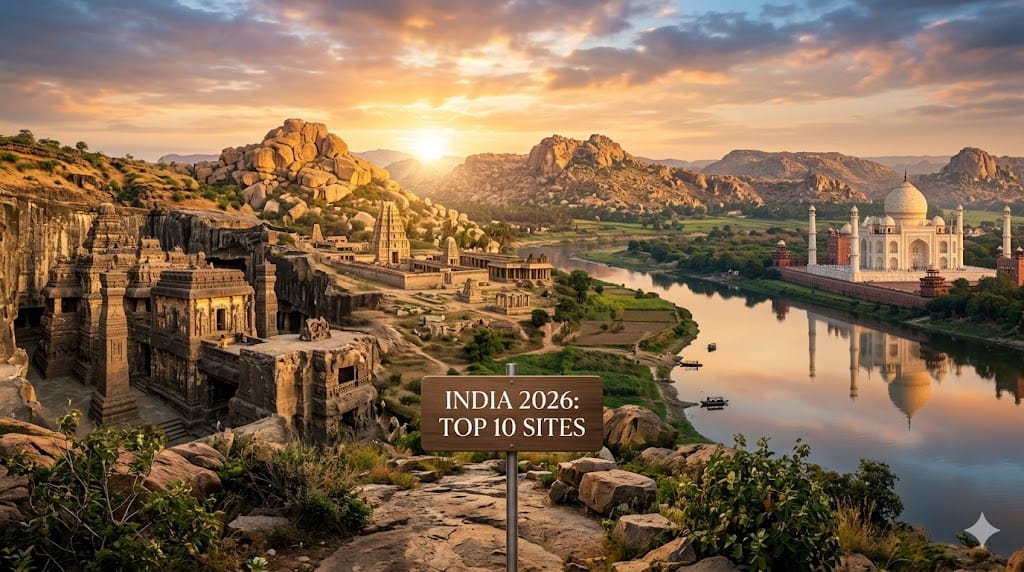
India is a land where ancient history and vibrant modern culture exist side by side. For travelers seeking to explore this rich heritage, the country offers some of the world’s most spectacular historic locations.
Planning a trip here allows you to experience the best tourist and archaeological sites in India that have shaped global history.
From northern marble palaces to southern rock-cut temples, every corner of this nation tells an incredible story. This curated guide will help you navigate the top historical treasures to include in your 2026 travel itinerary.
Exploring archaeological sites in India offers a unique glimpse into the past.
1. Taj Mahal
The Taj Mahal is a universal symbol of love and a recognized UNESCO World Heritage Site. Emperor Shah Jahan built this white marble mausoleum in the 17th century to honor his favorite wife, Mumtaz Mahal.
Its perfect symmetry, intricate gemstone inlays, and changing colors at dawn make it a true masterpiece of Mughal architecture. Visitors should arrive early in the morning to avoid the largest crowds and capture the best photographs.
Walking through the peaceful Mughal gardens offers excellent perspective views of the main dome. Be sure to book your entry tickets online in advance to save time at the gate.
2. Ajanta and Ellora Caves
Located in Maharashtra, these two cave complexes represent the pinnacle of ancient Indian rock-cut architecture. The Ajanta Caves date back to the 2nd century BCE and feature stunning Buddhist frescoes painted on dark cave walls.
Ellora features 34 caves dedicated to Buddhist, Hindu, and Jain traditions, carved directly out of the basalt cliffs. This complex is easily one of the best tourist and archaeological sites in India for art lovers.
The highlight of Ellora is the massive Kailash Temple, which was carved from a single rock from the top down. Bring a small flashlight to help you see the finer details of the ancient paintings in the darker cave rooms.
3. Hampi Ruins
Hampi was once the prosperous capital of the historic Vijayanagara Empire during the 14th century. Today, it is a vast, surreal landscape of giant granite boulders intermingled with the ruins of hundreds of temples and palaces.
The active Virupaksha Temple still stands tall near the local bazaar, acting as the spiritual heart of the village. Travelers often rate Hampi as one of the best tourist and archaeological sites in India due to its surreal boulder-strewn landscapes.
You can rent a bicycle or a lightweight moped to explore the massive archaeological zone at your own pace. Climb Hemakuta Hill just before sunset for an unforgettable view over the ancient, glowing ruins.
4. Khajuraho Group of Monuments
The temples of Khajuraho are famous worldwide for their complex architectural styles and detailed stone carvings. Built by the Chandela dynasty between 950 and 1050 CE, only about 20 of the original 85 temples still survive.
While famous for their erotic sculptures, the carvings actually represent diverse aspects of daily life, music, dance, and spirituality. The Western Group of temples is the most well-preserved and requires an entry ticket.
Strolling through the manicured lawns surrounding the sandstone temples offers a peaceful experience. Consider attending the evening light and sound show to learn about the history of the Chandela kings.
5. Qutub Minar Complex
The Qutub Minar in Delhi is the tallest brick minaret in the world, standing at over 72 meters high. Built in the early 13th century, it marks the beginning of Muslim rule in Northern India and showcases early Indo-Islamic design.
The complex also contains the mysterious 4th-century Iron Pillar, which has resisted rust for over 1,600 years. It stands proud among the best tourist and archaeological sites in India for those starting their journey in the capital.
Late afternoon is the ideal time to visit because the warm sunlight highlights the red sandstone carvings beautifully. The site is fully wheelchair accessible and has paved pathways throughout.
6. Sun Temple, Konark
Shaped like a giant ornamental chariot, the 13th-century Sun Temple in Konark is a masterpiece of Odishan architecture. It features 24 massive stone wheels pulled by seven horses, all intricately carved with symbols of time, seasons, and daily life.
The temple was designed so that the first rays of the morning sun would shine directly into the main sanctum. Though the main sanctuary has partially collapsed, the remaining audience hall is still highly impressive.
Be sure to hire an official government-certified guide to explain the astronomical significance of the stone wheels. Afterward, you can enjoy a relaxing walk along the nearby Chandrabhaga Beach.
7. Rani ki Vav
Rani ki Vav, or the Queen’s Stepwell, is a unique underground monument located in Gujarat. Built in the 11th century by Queen Udayamati, this stepwell was designed as both a water resource and a subterranean temple.
It was buried under silt for centuries, which perfectly preserved its seven levels of incredibly detailed stone carvings. This subterranean masterpiece is highly recognized among the best tourist and archaeological sites in India for its unique engineering.
As you walk down the stairs, you will see over 500 main sculptures depicting various avatars of Lord Vishnu. Visit in the morning when the sunlight reaches the deeper levels of the stepwell.
8. Sanchi Stupa
Sanchi Stupa is one of the oldest stone structures in India, originally commissioned by Emperor Ashoka in the 3rd century BCE. The great hemisphere dome protects sacred relics of the Buddha and represents the cosmic mountain.
Its most famous features are the four beautifully carved stone gateways, called Toranas, which depict scenes from Buddha’s life. The site is exceptionally peaceful and sits on top of a quiet hill surrounded by green countryside.
There is a small museum at the bottom of the hill that houses ancient coins and sculptures found during excavations.
9. Mahabalipuram Monuments
Perched along the coast of the Bay of Bengal, the monuments of Mahabalipuram were carved out of solid rock in the 7th century. This complex includes the sea-facing Shore Temple, the five monolithic rathas, and massive open-air rock reliefs.
The most famous carving is Arjuna’s Penance, a giant relief depicting the descent of the Ganges River. These coastal rock-cut marvels belong on any itinerary highlighting the best tourist and archaeological sites in India.
The sea breeze makes exploring the outdoor ruins very pleasant, especially during the cooler winter months. Try to visit the Pancha Rathas early in the morning to enjoy the softest photographic light.
10. Nalanda Mahavihara
Nalanda was one of the world’s first great residential universities, operating from the 5th century CE to 1200 CE. It attracted thousands of scholars and students from across Asia to study philosophy, astronomy, medicine, and Buddhism.
Today, visitors can walk through the excavated red-brick ruins of ancient classrooms, hostels, and towering temples. The most famous structure on the site is the Great Stupa of Sariputta, featuring multiple brick tiers and steps.
Walking through the ancient walkways gives you a true sense of the scale of this ancient center of learning.
Frequently Asked Questions (FAQs)
What is the best time of year to visit India’s archaeological sites? The best time to visit most of these historical sites is from October to March. During these months, the weather is pleasantly cool and dry, making outdoor exploration comfortable.
Do I need to buy entry tickets in advance for these monuments? Yes, it is highly recommended to buy your entry tickets online in advance through the official Archaeological Survey of India (ASI) website. Online tickets are often cheaper and allow you to skip long lines at the ticket counters.
Is it easy to find English-speaking guides at these historical locations? Yes, official government-approved guides are readily available at the entrance of almost all major monuments in India. Always ask to see their official ID card before hiring them.
How should I dress when visiting these ancient sites? Travelers should dress modestly when visiting historical and religious places in India. It is best to wear clothing that covers your shoulders and knees. Some active religious sites will also require you to remove your shoes and cover your head before entering.
Journey Through India’s Living History
Exploring the best tourist and archaeological sites in India is a journey through time that leaves a lasting impression on every traveler. From the precision of the Taj Mahal to the raw rock-cut beauty of Ellora, these monuments show the incredible creative spirit of past civilizations.
Planning your visits carefully, respecting local customs, and hiring local guides will ensure an enriching adventure. As you travel to these ancient wonders in 2026, you will experience firsthand the stories that continue to shape the modern world.